
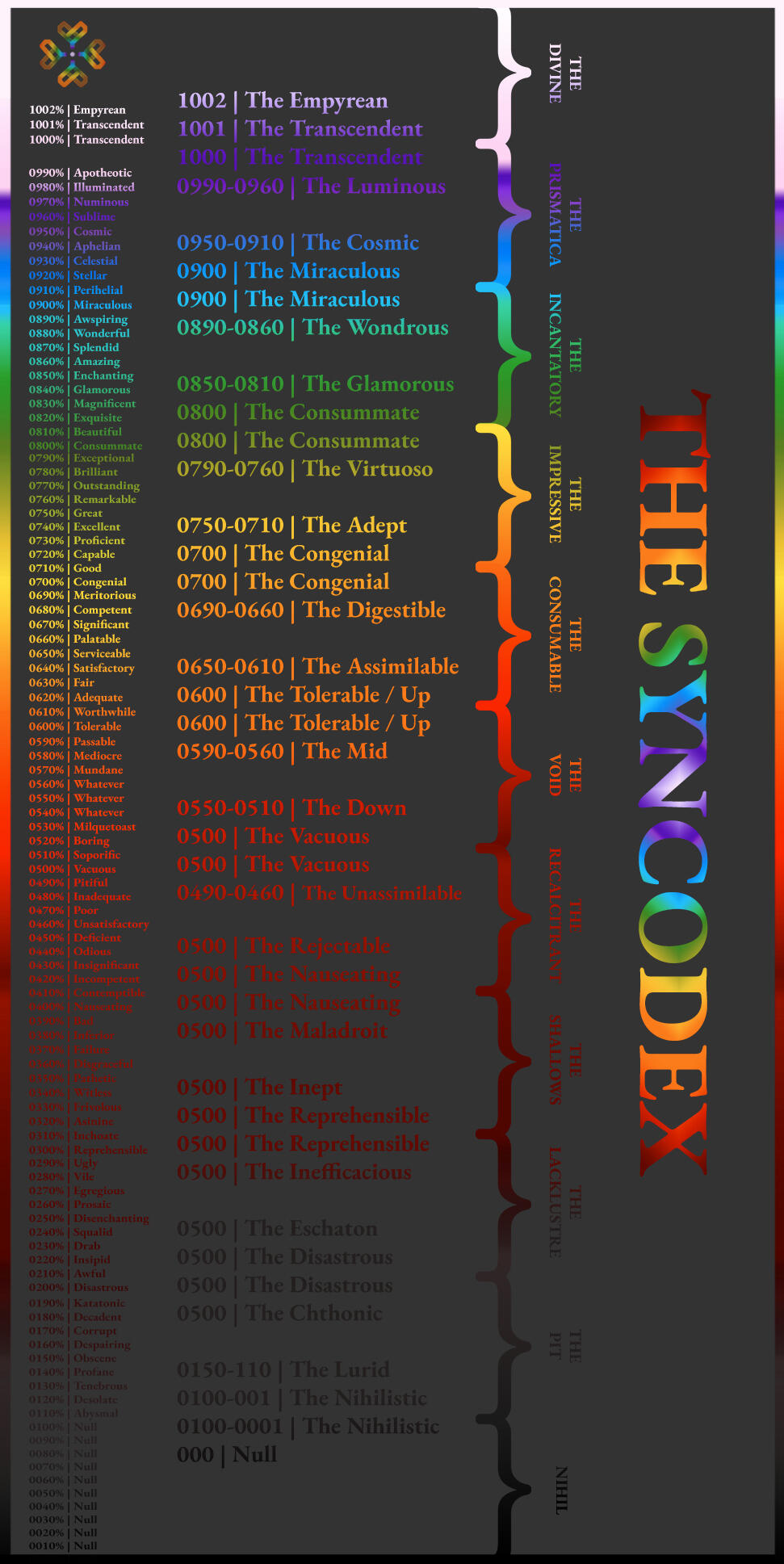

Example - Hello :)

Example - Hello :)

Domain 8b - Refer to footnote-D8 (Domain 8) above in the footnotes of The Miraculous.Band 25 - 'Wonder' derives from wundor, ('a miracle'), which comes from the proto-Germanic wundrą. The etymological roots go deeper but are unknown. Many linguists have connected it to the Proto-Indo-European wen- meaning 'to wish for.' And so, in The Syncodex, miracle and wish are conjoined through awe.

Found an Old Soul in the Forest photograph of pareidolia by Lori McGrath (2025).
13 - Who is The Green Man? Good question. He is an artistic motif used in the masonry of Medieval cathedrals, sometimes used to depict Dionysus/Bacchus and popularised by 19th-century British Druidry. His appearance - a head of leafy hair, a vining beard, grassy eyebrows - thematically binds our species to nature, which befit Druidic beliefs and led to their adoption of him as a pagan symbol. But we don't actually know where The Green Man came from before the Gothic medieval. In this context, The Green Man represents the volatile union between nature, man, architecture, and art - as well as their declining states of 'potency' ('natural' magic). The Green Man encountered in the woods - prowling the periphery out the corner of the eye for an instant before evaporating - has a greater potency than the one encountered in the kitsch pagan store of a shopping centre.
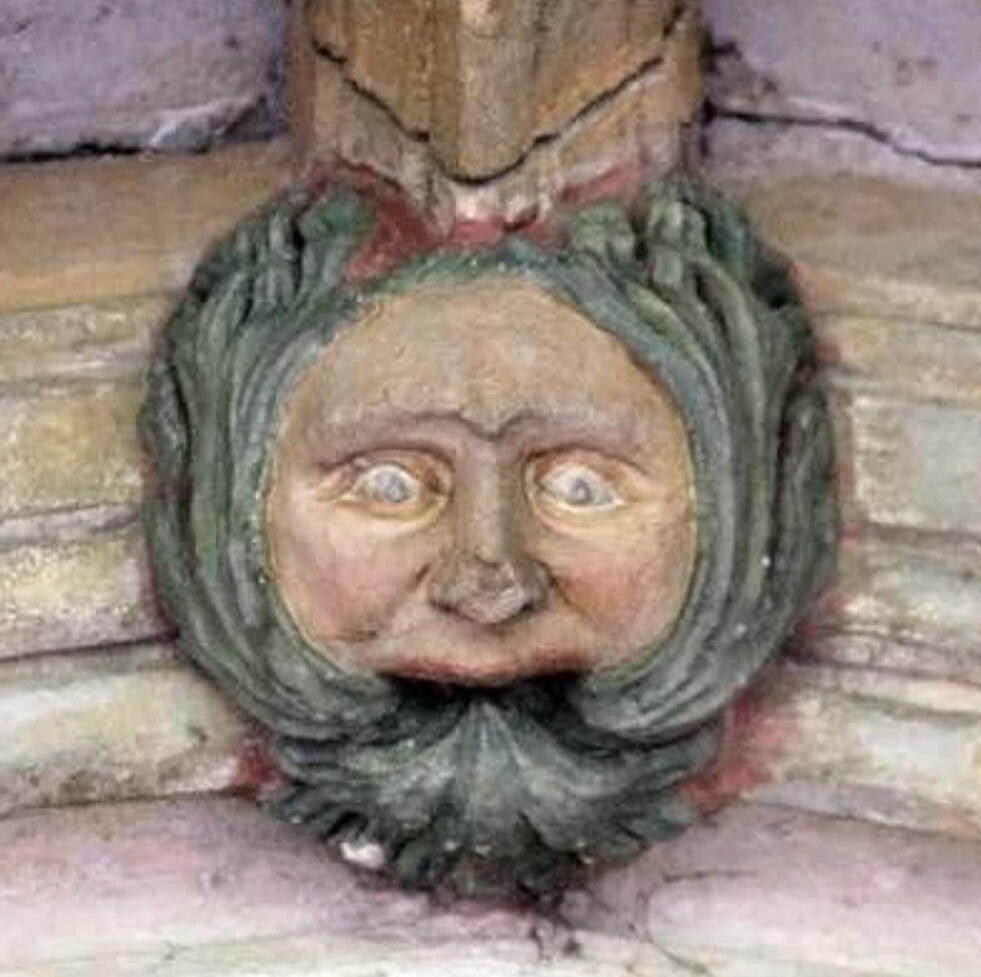
In the Cloister at Canterbury Cathedral photograph of head roof bosses by Lucy Miller (2021).
14 - 'Awe' has both negative and positive connotations attributed to it, though it was brought to English during the 13th-century via Vikings in the form of paralysing agi ('terror', 'dread,' and 'discipline'). Definition of the 'sublime' throughout the 18th-century resulted in a redefinition to 'when terror meets fascination.' Eventually, 'awe' was split into 'awful' with the 1960s popularising 'awesome.' Which to me implies 'some awe' and doesn't match the magnitude of its definition.Step 89 - Combine prefix awe- ('reverential respect') with the suffix -spiring ('to breathe') and you arrive at 'Awspiring.'Step 88 - Refer to footnote-B25 (Band 25).15 - The Wondrous (upper half of [The Incantatory]) possesses an immanent (autochthonous, native without external pollution) ray aspect of The Divine (let's say: 50% > natural). Whereas the incarnate impositions of The Glamorous (lower half of [The Incantatory]) gradually decrease that same quality (< 50% natural).Step 87 - Like 'awesome,' 'splendid' has been adopted by the British for colloquial (hyperbolic) politeness which has resulted in the reduction of its meaning: deriving from splendidus and splēndēre ('to glitter' or 'to gleam'), the original implication conveyed an optic shock due to bouncing light.
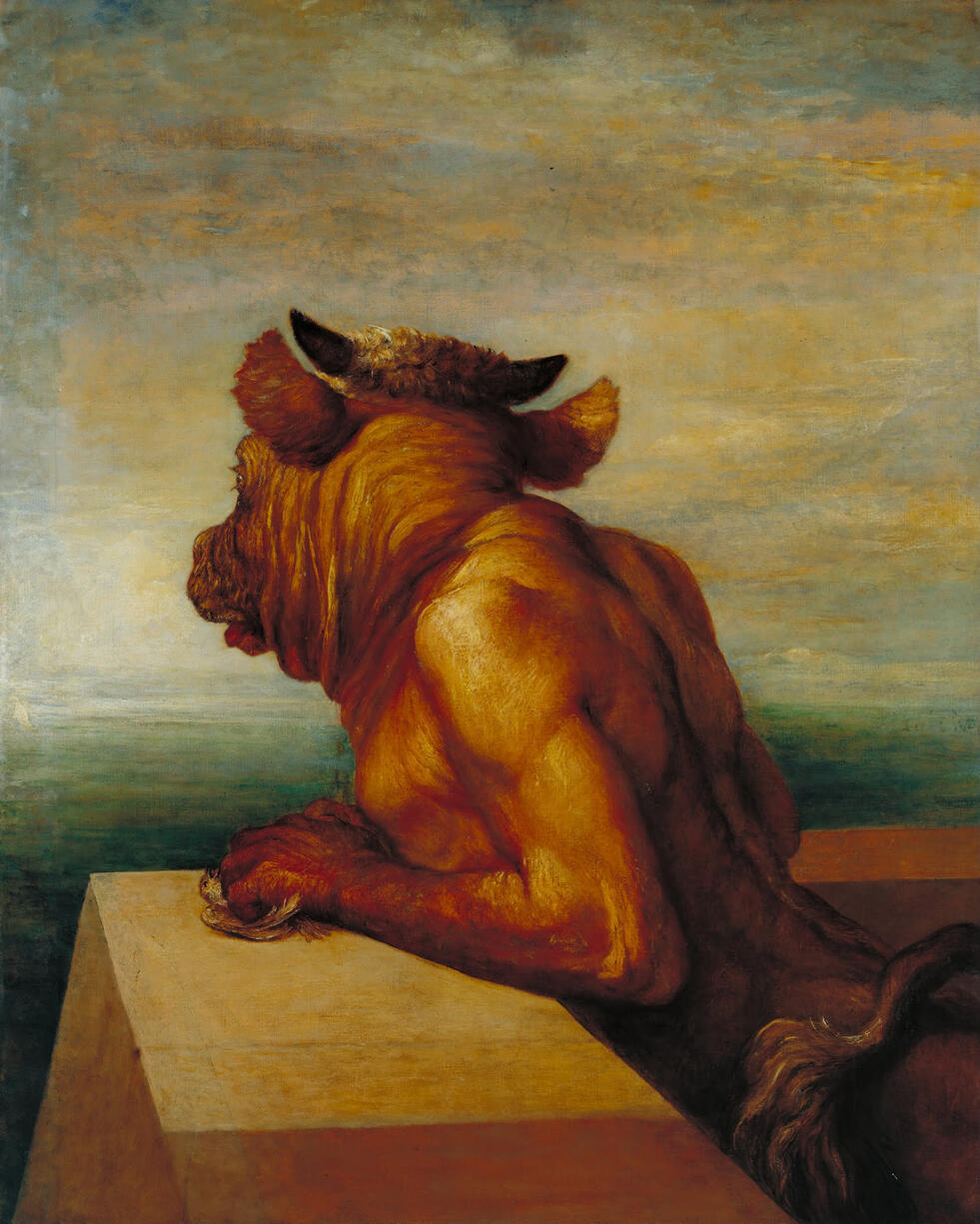
The Minotaur by George Frederic Watts (1885).
Step 86 - Amaze derives from 'maze' and means 'to be overwhelmed or confounded with sudden surprise or wonder.' Something mazy is 'winding, intricate, like a maze.' Around the 1300s, the Middle English āmasian was coined to define 'a state of bewilderment.'16 - The separation of art and science is a later, post-Renaissance compartmentalisation foreign to the classical Greek. Erwin Schrödinger in his 1944 book What is Life? wrote that life resists death (survives) by 'drinking negative entropy.'
'Perhaps we should ponder more deeply on the fact that Daedalus means 'artist' in Greek. Daedalus, designer of labyrinths, imprisoned by those he served in a labyrinth he himself built. [...] Why does he represent Art, instead of Science? [...] remember that the ancient Greeks did not distinguish 'Art' from 'Science' as we do. The genius of an artist, Aristotle says, lies in his texne, the root from which we get our word 'technology;' but texne basically means skill or craft, or the ability to make things that never existed before. Negative entropy, i.e., information.' - E-Mail to the Universe by Robert Anton Wilson (2005).
'Any sufficiently advanced technology is indistinguishable from magic.' - Profiles of the Future: An Inquiry into the Limits of the Possible, the Third Law by Arthur C. Clarke (1962).
Therefore: 'any technology distinguishable from magic is insufficiently advanced.' - Gehm's Corollary by Barry Gehm (1972).
17 - 'Kayfabe' is etymologically difficult to pin down... Read my thoughts on kayfabe, here.
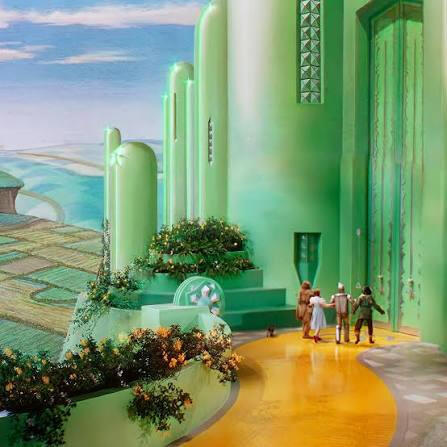
The Wizard of Oz directed by Victor Fleming (1939).
Band 024 - You can use grammar - a cognitive grimoire (a word-hoard) - to cast a glamour on someone, thus pulling the wool over their eyes. "To him the eldest answered, the leader of the troop, unlocked his word-hoard." - Beowulf, Line 258b.18 - I'm referring to The Wonderful Wizard of Oz by L. Frank Baum (1900) if you didn't know. The book was released the same year as Sigmund Freud's Interpretation of Dreams - yet rivals its oneirological (dream studying) utility through multiple wonderful metaphors. Appropriately: the 'Yellow' Brick Road leads to The 'Emerald' City. Less appropriately: Dorothy was whisked away by tornado to the 'blue' Munchkinland, where I would have had it come after The Yellow Brick Road and Emerald City (and before an 'Indigo' Car Park or something). Anyway: adapting the book to film by taking advantage of the new technicolour multi-strip process was a stroke of genius on behalf of the director, Victor Fleming (1939), who chose to omit 'Wonderful' from the name and changed the silver-slippers to ruby-slippers in the process.Step 85 - Refer to footnote-B27 (Band 27). It appropriately shares the Latin root with the word 'enchant.' Within the context of The Syncodex, the wave mechanics of this musica universalis ('music of the spheres') filter through [The Prismatica] into something awspiring. This song resonates through The Syncodex but notably decreases in gain and dynamics below the point of enchantment ('to chant upon, sing magic over, or charm'). 'Universe,' derived from the Latin universum, meaning 'one turn, altogether' and ultimately 'the cosmos,' shares etymology with versus (of a song's verse) but the idea universe means 'one song' is a lovely poetic myth. Otherwise, refer to footnote-D8 (Domain 8).19 - 'Athanor' derives from the Arabic al-tannūr(التنور) and means 'the oven.' It was co-opted by alchemists to describe a furnace engineered to maintain a continuous and perfectly uniform temperature over an extended period of time with minimal impurity or tainting in the result (if any at all). Whether or not they physically existed is a matter of debate, but they suffice as a metaphor for an alchemical machine of transformation along the lines of a perpetual motion machine.Step 84 - Refer to footnote-B24 (Band 24).Step 83 - 'Magnificent' derives from the Latin magnificus - 'making great deeds' - and developed its definition of grandeur in the 1520s. It's suitability here is dependent on the immanent creativity behind the root facere (of which the sufix -ficus derives and means 'to make') at the apex of The Glamorous; and the root magnus which shares Latin roots with 'magnificat' (the Song of Mary), 'magnify' ('to enlarge or exalt' and other such words carrying a greatness of scale.20 - As we descend through lesser spiritual wavelengths, we increasingly let in daimon genius (gignere - 'generate') through the daimonion 'inner-voice.' The top-half (550>) of The Syncodex is relatively eudaemonic where the bottom half (<550) is cacodemonic. Panic enters (via Pan) in [The Recalcitrant], unassimilable lower-half. Angels (angelos - 'messengers') are the product of Christianity demonising daemons, bilaterally resulting in the 'good guiding spirit' and the 'bad guiding spirit.' The author sees no distinction between demon and angel but in the mind. As John Milton (or Satan of Paradise Lost, Lines. 254-255, & 263 ) puts it: 'The mind is its own place, and in itself can make a heaven of hell, a hell of heaven.. [...] 'Better to reign in Hell, than serve in Heaven.'Step 82 - Modern usages of 'exquisite' carry connotations of 'delightful excellence' or 'careful grooming' which appropriately position it between magnificence and beauty. However, the word derives from the Latin verb quaerere - meaning 'to seek' or 'to ask' - of which 'inquire/enquire and question' stem from. Usage here conveys not only the attractive attentiveness employed by both magician and audience (the smitten), but an initiation of curious communication, mirroring the etymologically wishful sentiments of wonder found near the top of [The Incantatory] (which some believe coalesce into miracles - often through the stars).Step 81 - Beauty stems from the root deu- ('to revere') which evolved into the Latin duonus ('bonus') and the diminutive bellus (which became beauté) until the 15th-century where we find 'beautiful.' Etymologically adjacent words include 'embellish' ('to make something prettier through decoration) and 'beatify' ('the first step towards miraculous sainthood, blessed upon the holy departed').
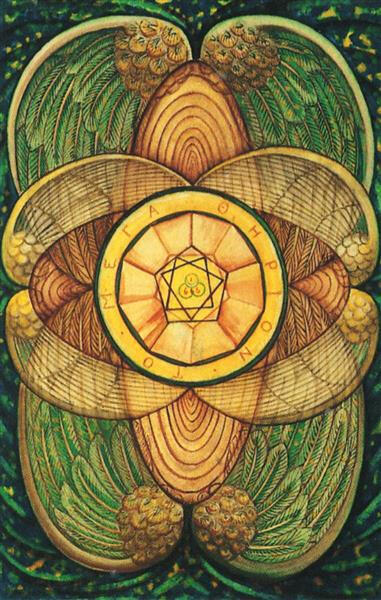
Ace of Disks by Lady Frieda Harris (1938-1943).
Band 23 & Pivot 8 & Step 80 - Derived from the Latin consummatus - 'brought to completion' or 'bring together' - and built from the prefix con- ('together') and summa ('peak'), 'consummate' represents both a pinnacle of skill, and this step/band's dual-nature as a pivot.21 - Edmund Burke defined the 'beautiful' as 'well-formed and aesthetically pleasing' and the 'sublime' as having the power to 'compel or destroy.' Immanuel Kant took his system and systemised it. For Kant, the beautiful relates to manifest form where the sublime contends with the formless or infinite. You can see something not too dissimilar, here, with [The Divine] transitioning through [The Prismatic] into [The Incantatory]. However, to me, the sublime possess an arcane wisdom, whereas the beautiful appeases the aesthetic senses. Sublime things can be beautiful but I find 'merely' beautiful things incapable of reaching the spiritual climax of gnosis required for my sublime.Domain 7 - The Latin prefix in- ('upon/into') and the verb premere ('press' - the root of 'pressure' and 'depress') build the verb imprimere. It conveys 'a stamping, an imprinting, a marking' which gained a metaphorical substrate in the 15th-century until arriving at the common remark of 'memorable admiration.' Meanwhile, 'expression' is the 'squeezing' of cognition into word: [The Incantatory].

Domain 9 - 'Prismatica' is the author's invention. It is a spiritually toponymic substantivization of 'prismatic' formed to denote an ontological space and process/hyper-object: a prismatic domain of divine refraction. Timothy Morton coined 'hyper-object' to refer to concepts or systems which surpass spatio-temporal containment or definitive measurement. Common examples include climate change, biosphere, the internet, capitalism, and black holes.2 - The Greek indikon ('from India') entered the English language in the 13th-century, and 'violete' ('concerning the viola flower') in the 14th-century. Despite this, Indigo and Violet - the colours - were discovered by Sir Isaac Newton in 1672 and 1704 respectively. Before then, they were not perceived as independent colours but as purple. Purple is a creation of the human brain, the result of perceiving long (red) and short (blue) wavelengths at the same time. That does not make purple a 'fake' colour since all colours are neural interpretation generated by the brain. Nonetheless, it is rare in nature, often requiring complex pigmentation. This rarity historically imbued purple with cardinal traits of spirituality and royalty. With time, the colour - once reserved for the (Tyrian) rich or (clergy) holy - was appropriated for aesthetically alien purposes alongside the 'The Grey' and the 'Little Green Man'. The green on Earth comes from chlorophyll due to photosynthesis, whereas many scientists now believe extraterrestrial life could theoretically take on a purple hue through bacteriochlorophyll and carotenoid absorption of infrared radiation. Similarly, the purple 'magical auras' of 'evil' or 'dark' characters in fantasy represent an association with the unknown. What of pink?
[[[[Talk about Dark Side of the Moon.]]]]
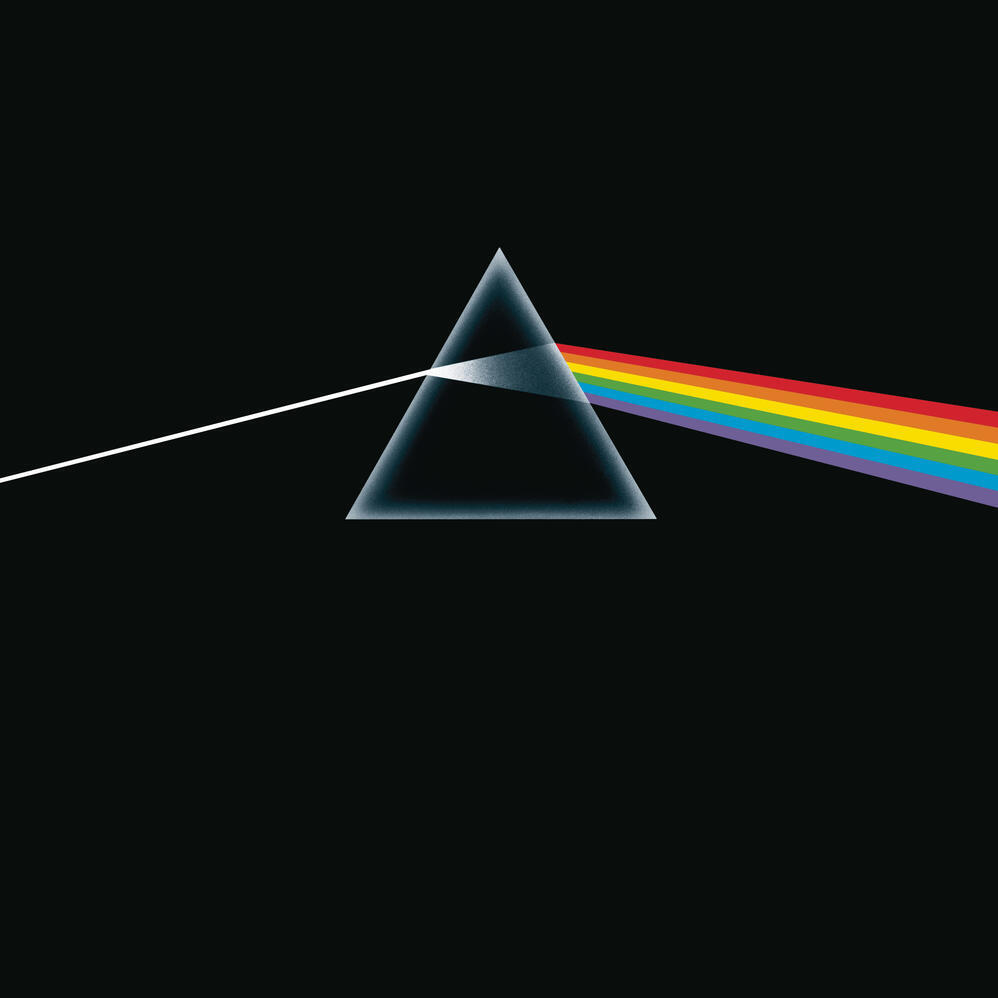
The Dark Side of the Moon by Pink Floyd; artwork by Hipgnosis (1973).
Band 28 - 'Luminous' derives from the Latin lumen meaning 'light' (itself derived from lucmen). First used to describe literal emission, it was later adopted to describe a spiritual radiance. Similar words include 'luminary,' 'lucid,' 'translucent,' 'elucidate,' 'illustrate,' and the Latin word for the Morning Star (Venus): 'Lucifer - The Light Bringer.' What's important to note, here, is that we still concern ourselves with a divine spirit transmuting through light, and not sunlight or moonlight. Though the Latin word for luna comes from the same root as lumen and its cousins, that is because the ancients saw the moon as the shining giver of the night sky. For this reason, 'lunatics' were those who changed moods with the phases of the moon.
Otherwise, the influence of moonlight (charging through selenian emission) can be felt in The Miraculous junction between [The Prismatica] and [The Incantatory] (for Luna does not emit light but reflects Sol's). The 'moon' - derived from the Proto-Indo-European root me- ('measurer' - where we get 'meter' and 'symmetry') - is intrinsically connected to 'magic' - ultimately derived from the Persian magus (a class/tribe of astronomers and astrologers). They intersect through the Greek goddess of the night, magic, moon, and crossroads: Hekate. We'll return to Hekate later.Step 99 - The prefix apo- ('away,' 'separate'), theos ('god'), and the suffix -osis ('state change') build 'elevation to godhood'. Once pertaining exclusively to the deification of a mortal, the secularised definition implies an absolute high-point; a coronation surpassed only by terms, expressions, and states of the unlimited. The phrase 'apotheotic descension' might seem paradoxical, but here it implies a descent (or state change separation) from divinity applicable only due to our downwards trajectory. 'Enthusiasm' ('godly inspiration') is a prerequisite for apotheosis; the 'apokálypsis ('unveiling') implies a 'revelation' - an opening of the eyes (which is why the titular book of the Christian Bible concerns prophecy). Because such a revelation implies the end of a world and the beginning of another, common usage of apocalypse imply a cataclysmic finale often paired with imagery of Hell. Historically apocalyptic events include The Scientific Revolution of the 16th/17th-century and the Trinity Nuclear Test (the detonation of the first atomic bomb in 1945). Likewise, the collapse of the Bronze Age and the fall of the Western Roman Empire. You could even describe the collision of worlds, such as the European invasion of the Americas from 1492 onwards, as apocalyptic. The katechon is the word used to describe the force that pushes back the apocalypse, the beginning of a new world at the cost of the old. Whether you consider that force a good or bad thing depends on your definition of apocalypse at any given time. Billionaire Peter Thiel considers our current katechon a bad thing, as he construes it with the anti-Christ by pairing the apocalyptic rise of artificial intelligence with the Second Coming. Remember that Thiel runs Dialog, an ultra-secret invitation-only social club. There, they run seminars on nuclear power, cult-building, artificial intelligence, deepfakes, World War Three, and money buying happiness. We will return to eschatology much, much later.Step 98 - Refer to footnote-B28 (Band 28).Step 97 - The word 'numinous' entered English parlance around the 17th-century, derived from the Latin numen ('a nod of the head') to confer the transmission of divine will. Rudolf Otto (1917) defined the numinous as an awe-inspiring, mysterious, tremendous, terrifying experience of the divine (mysterium tremendum et fascinans). The process so far is spiritual comparable to the three Kabbalistic veils of infinite energy before physical existence. Ain (Nothingness), Ain Soph (Limitless), and Ain Soph Aur (Limitless Light). 'Innuendo' derives from the same root.Step 96 - 'Sublime' derives from sub- ('under') and limen ('threshold'), suggestive of an exalted state beneath a precipice (here: a boundary where unmanifested light condenses into a physically defined matrix). Crossing that 'precipice' is tantamount to emerging from an 'event horizon' of a white hole - the time-reversal of a Schwarzschild radius where the mathematical roles of space direction and time coordinate swap. While a black hole pulls matter inwards to singularity, a white hole expels through genesis by pushing energy and matter outwards, forcing potentiality to 'amass[es] density [as it] plummets into three-dimensional space-time.'3 - This is reflected in Percy Bysshe Shelley's writings on the sublime as a secularised expression of Rudolf Otto's divinely numinous.
Band 27 - Before Pythagoras applied it to the universe, kosmos ('arrange') described the profound mundanity of organisation. It is the opposite of khaos ('a disordered void') from which we derive 'chaos.' Pythagoras proposed the movements of the planets and celestial bodies create an invisible and harmonious mathematical order. Within the context of The Syncodex, the wave mechanics of this musica universalis ('music of the spheres') filter through [The Prismatica] through a white hole of cosmic creation into something miraculous and awspiring.4 - From the Greek holo- ('whole,' or 'entirely') and photic ('relating to light').
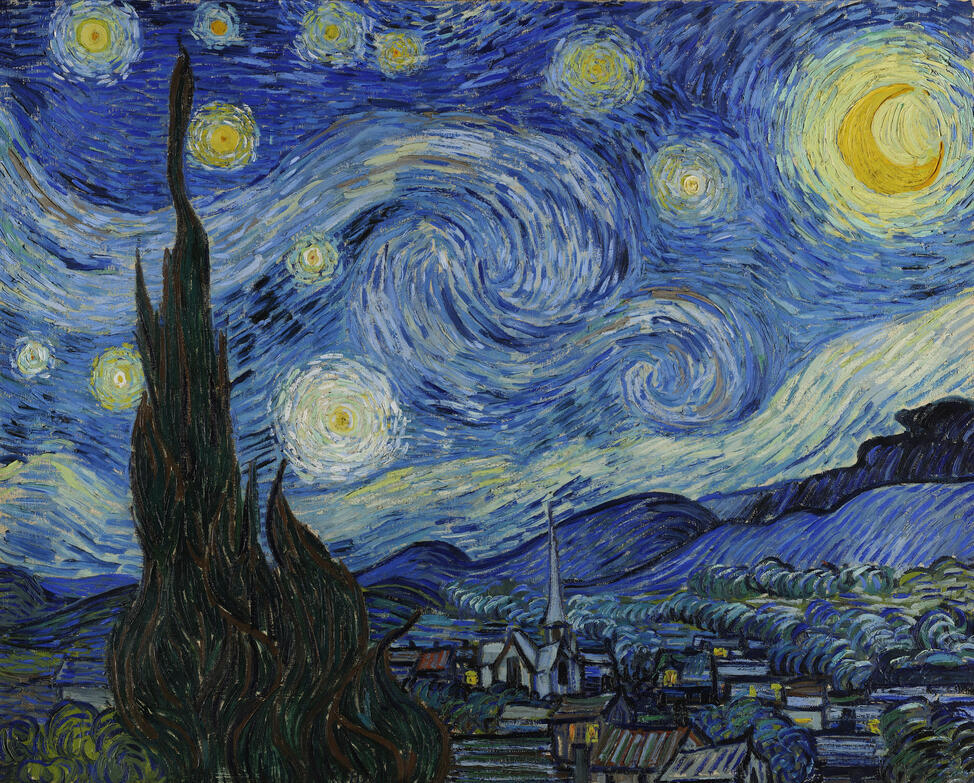
Starry Night by Vincent van Gogh (1889).
5 - Demons 'exist' for scientists to dispel. Maxwell's Demon is a thought experiment proposed by James Clerk Maxwell in 1867. What if there was an imaginary being in control of a microscopic door between two gas chambers? The creature - a demon - aims to decrease entropy without any work, therein challenging the second law of thermodynamics (in an isolated system, entropy/disorder increases with time). The demon does this by allowing fast/hot molecules to go one way while allowing slow/cold molecules to go the other. (Contemporary physics has resolved this conundrum by proving that the conduction and erasure of information will always require physical energy). In the case of the Syncodex, then, Maxwell's Demon is a gatekeeping imp sitting at the threshold of the holophotic/liminal and the astronomical. Comparatively, Laplace's Demon (wonderfully, Laplace means 'the place') invokes an omniscient creature knowledgeable of the precise position of every atom (and its momentum). This demon could theoretically then calculate every past and future. Similarly, Loschmidt's Demon (Loschmidt translates to 'blacksmith') aimed to challenge the second law of thermodynamics in 1876 (through reversal of particle velocity to reverse the 'flow' of time). In 1956, David Pines invoked the Pines' Demon (demon, here, short for distinct electron motion) to describe energy bands oscillating out of phase. His prediction was confirmed in 2023. There are plenty of demons out there.Step 95 - Refer to footnote-B27 (Band 27).6 - 'Cobalt' derives from kobalt (itself derived from kobold - the Germanic imp). Miners believes it harmed silver ore as the presence of cobalt-bearing ore made extraction of silver a more arduous task. Here, it represents the chromatic shift between indigo and blue - a blue-tinged silver evocative of the divine light - while pairing the colour with etymological demonology (and a subsequent transition to bound physical laws).
Step 94 - Johannes Kepler coined the term 'Aphelion' in the 1600s to describe something at the 'absolute farthest point from the sun within a celestial orbit.' Similar to 'apotheosis' it derives from apo- ('away,' 'separate') but appended with helios (Ancient Greek for 'sun,' Helios being the sun god). After Kepler and Copernicus proved heliocentrism, the term 'apogee' ('absolute farthest point from the Earth') fell out of popularity. Therefore, 'perihelian' is the adjective form of 'perihelion' where peri- means 'around' or 'close to' the sun.Step 93 - The ancient Proto-Indo-European root kail/keil- ('whole sky') became the Latin caelum ('the heavens'), the term accruing greater spiritual significance with time until the 16th-century Scientific Revolution where it was adopted by astronomers for secular purposes of mapping the 'celestial.' Now, it means both these things, appropriate for the mechanical inner-orbit yet nonetheless divine.
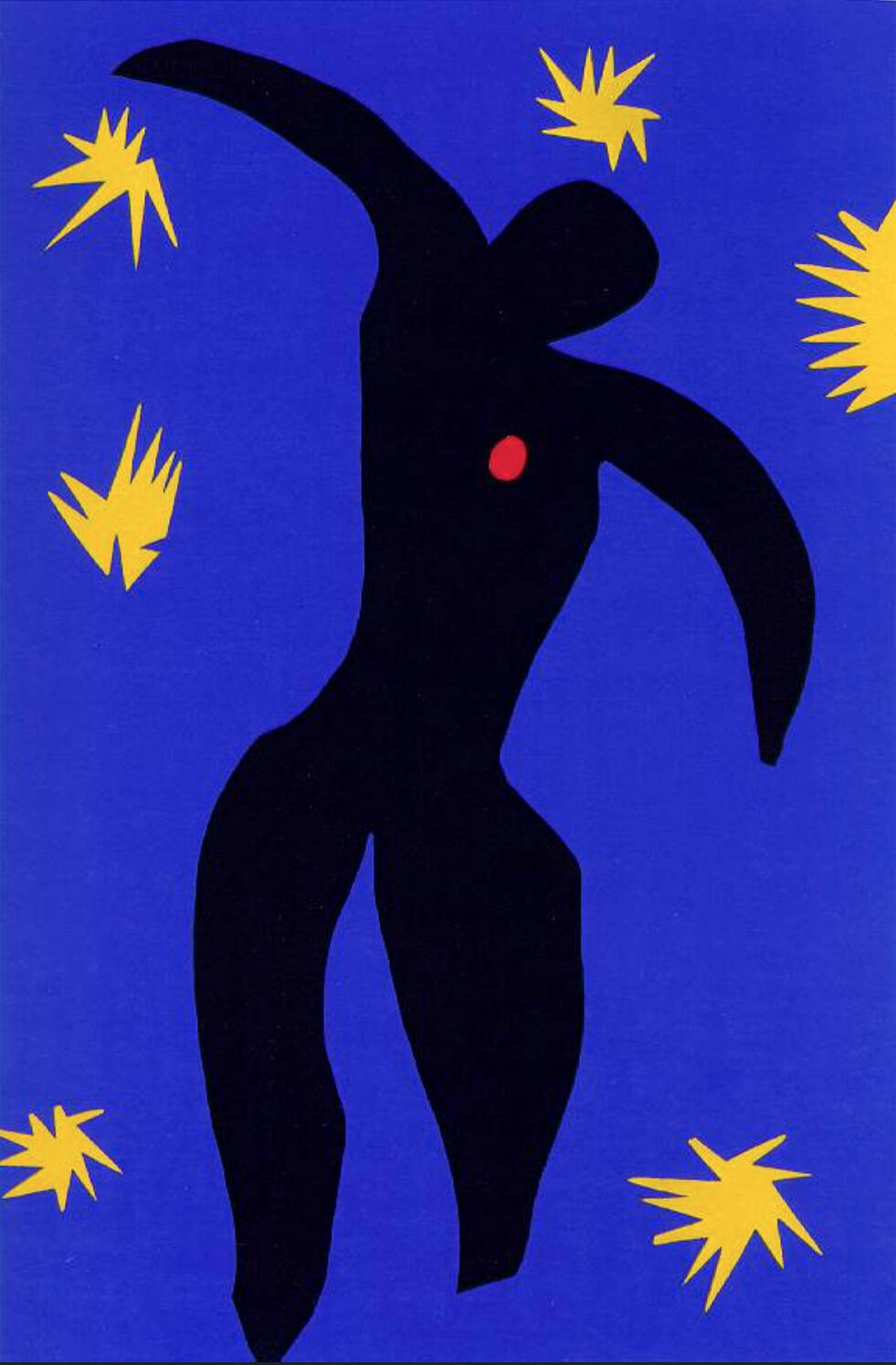
Icarus by Henri Matisse (1943-44).
Step 92 - It stands to reason that we would encounter the stellar, here, as we proceed from the furthest point of a central star and through the celestial yet have not reached the central star itself. Simply, stella is Latin for 'star.' When they group they form a 'constellation' (con- means 'together'). Asteriskos - asterisk (*) - means 'little star.' Minos (the King of Crete) named the Minotaur Asterion (or Asterius, also 'little star') after his father. We'll enter the labyrinth soon, and 'disaster' ('away from the stars') much later. But here, in [The Prismatica], is where we first meet the 'monster.' Monstrum - meant 'divine omen' before its manifest reduction through monstrare ('demonstration') into simply 'misfortunate' or 'malformed.' The best monsters are warnings: Godzilla, the Cyberman, Frankenstein's Creation, Jörmungandr, the Nazgûl, Gregor Samsa, the White Walkers, Polyphemus, HAL 9000, the Dragon, the Vampire, the Vashta Nerada, The Thing, the Zombie, Dorian Grey, the Leviathan, the Human. Peter Benchley - author of the 1974 novel Jaws - famously regretted his contribution towards the demonisation of sharks. Likewise, Steven Spielberg lamented the misconceptions derived from his 1975 adaptation which has resulted in decades of shark decimation. The shark is an inappropriate monster - divinely ominous only for our cold-blooded ability to use the prejudicial language of visual propaganda to incite phobia and violence. Now, on the other tentacle, the Kraken...7 - The nervous system is commonly depicted in medical science with yellow. Blue often depicts blood. Nonetheless, the author's experience with textbooks, documentaries, and science-fiction films project a blueish, electro-intergalactic tinge upon the peripheral nervous system (and synaptic response). Perhaps because of the way electricity appears blue to the human eye due to gas ionisation and light emission. I've kept this to reinforce the nebulousness of the nervous system.
Step 91 - Refer to footnote-S94 (Step 94).8 - The word omphalos means 'navel' (an 'anatomical centre') in Greek. The author John Higgs compares it to the (0,0) midpoint of a Cartesian co-ordinated graph. He suggests humanity once operated under an 'omphalos illusion' of an absolute centre, before Einstein came along. By proving special relativity, Einstein dismantled this 'omphalos illusion' to help incur the relatively-bouncing world of 'reality tunnels' (phenomenological umwelts we now live in).
'The cosmos is within us. We are made of star-stuff. We are a way for the universe to know itself.' - Carl Sagan (1980).
'Every man and every woman is a star.' - Liber AL vel Legis by Aleister Crowley (1904).
In quantum mechanics, an eigenstate (eigen- means 'own' or 'characteristic') is what we call a measurable outcome - which is something observable; the resulting function of a wave. When something is observed, its many possibilities reduce to one. We call that the wave function (Ψ) collapsing. That symbol (Ψ) denotes the Greek letter psi - it is pronounced 'sigh' and is the universal symbol for 'psychology' (ψυχη - 'psyche'). Erwin Schrödinger (1926) adopted it out of mathematical habit to argue against the possibility of wave function collapse, but by historical irony the symbol illustrates the precise collapsing of two states into one he strove to disprove. Now, in legalese and bureaucratic doctrine, a scintilla (Latin for 'a spark' to mean 'a tiny trace' or 'hint') represents an infinitesimal interstitial, transitionary moment where something possible manifests into actuality. Schrödinger's Equation measures the process of time before the state of something observed collapses into an eigenstate: the scintilla of being. Through another historical irony, he created his Schrödinger Cat paradox to ridicule Copenhagen physicists like Heisenberg and John von Neumann for their weird ideas on the quantum - yet the absurd thought experiment was adopted by his opposition for its apt explanation of quantum weirdness, instead.
Put simply: Imagine a cat inside a steel box. Inside that box and besides the cat, you leave an atom (the tiniest amount) of radioactive material, a Geiger counter, a tiny hammer, and a vial of poison. The radioactive material is governed by Schrödinger's Equation, so there is a 50% chance the atom will decay and 50% chance it will not. If the atom breaks down, the Geiger counter registers it and drops the hammer, shattering the vial to release the poison and kill the cat. There is a half chance of that happening. You return after an hour: what is the state of the cat before the box is opened? According to Copenhagen logic, the atom's unobserved wave-function remains in a fluid superposition; the counter both did and did not go off; the hammer both did and did not drop; the vial both shattered and did not shatter; the cat is both 100% alive and 100% dead.
It is a complete 'coincidence' that resulted in Ben Jonson's (1598) 'care'll kill a cat' transforming into 'curiosity killed the cat' with time and no association to Schrödinger. Similarly, Shakespeare's (1597) abridging of the phrase, 'a cat has nine lives' delineates the limitations of single-digit operations in a Base-10 system. Let's not forget the phrases "let the cat out of the bag' (an expression perhaps originating in livestock farmer frauds, where you'd replace a pig with a cat and hope the buyer doesn't open the bag); or 'there is more than one way to skin a cat' - which is another expression of determining possibility dressed up in the feline macabre. We will refer to the theoretical hyper-object involved in the Schrödinger's thought experiment as a 'catbox' (inspired by Ryukishi07 and his work Umineko no Naku Koro ni).
The prospect of a 'solely participatory universe' where 'the lights go out when your light goes' out has always felt redundantly solipsistic to me. Nonetheless, I can't dispute the confounding results of quantum interference. The dual-slit experiment demonstrates how observation or measurement of a wave fundamentally changes its behaviour from wave to particle. Let's elaborate. Imagine a wall with two slits cut into it. Behind the wall is a 'detector screen' - say, a wooden-board. When we roll marbles (representing particles) through the slits we find two straight lines: piles of marbles behind the openings. Sensible enough. Similarly, when we send waves (water or light) through the slit, they split into two new waves that crash into (interfere with) each other, resulting in alternating patterns of interference upon the board. We see bright and dark 'stains' (in the case of light waves) or choppy and calm 'stains' (for water waves) on the wooden-board. Here's where it gets complicated. When we send a single quantum (the minimum, smallest possible) object through the slit - like an electron or a single photon particle of light - it develops an interference pattern on its own. To reiterate: each single particle also possesses a probability of a wave, in effect passing through both slits simultaneously to interfere with itself upon the wooden-board. We find straight line piles and wave interferences. Somehow those particles are also waves. So we install a measuring device (a camera) at the slits to measure which path the particle takes. Yet the moment we attempt to observe or measure, the wave interference patterns upon the wooden-board vanish as the particle acts like normal: two simple lines upon a wooden-board. Most agree that this 'measurement problem' shows how the act of looking at a quantum system forces it to pick a definite reality. What does this mean? Well, though there are roughly twelve notable frameworks actively debated by physicists and philosophers, we will concentrate on the five prominent contenders of which the other seven are mutations.
One: reality conforms to measurement. The Copenhagen Interpretation claims the particle (or to use Schrödinger's example: the 'atomic radioactive material' and the 'fate of the cat') never had a fixed, objective past state to begin with. It existed in a fluid superposition of all possibilities until interaction - whereupon these possibilities collapsed into one: the verifiably perceivable. So, the cat is dead and alive, its definitive fate determined by our lifting the lid off the catbox. It is inaccurate to say we are 'changing' a past that was 'written' and more accurate to say we are 'choosing' which past gets 'written out.' 'No elementary phenomenon is a phenomenon until it is an observed phenomenon' (John Wheeler, 1977).
Two: measurement retrocausally rewrites reality. The Retrocausal (Transactional) Interpretation suggests observing the particle retroactively changes its history. Our decision to measure sends a causal ripple 'backwards,' altering what happens upon measurement. By observing the cat, we change the history of the atom, 'rewriting' the cat's history after the fact. 'The transaction is a 'handshake' across space-time between the emitter and the absorber' (John Cramer, 1986).
Three: both. The Many-Worlds Interpretation suggests both happened. Reality never collapses and history is never rewritten. Instead, observation incessantly splits the universe into a multiverse, creating all possible outcomes of quantum measurement across infinite parallel realities - of which we only occupy one. When we open the catbox, we split also - a parallel version of us lifts the cold feline out, while we stroke its warm head. 'All elements of a superposition (all 'branches') are actual, none any more 'real' than the rest' (Hugh Everett, 1957).
Four: neither - personal information changes, not reality. Quantum Bayesianism (QBism) suggests that the reality of the particle doesn't collapse or rewrite upon measurement, the observer simply updates their knowledge of it. The cat was always 100% alive or 100% dead. The superposition merely reflects our personal ignorance. Lifting the lid off the catbox only updates our understanding. 'A quantum state is not an objective property of the world [but] a mathematical expression of an agent’s personal probabilities' (Christopher Fuchs, 2010).
Which brings us to five: nature. Objective Collapse Interpretations argue that we cannot account for the unobserved until observation, as observation would make it non-unobserved. Wave-functions change despite the observer. Gravitational instability forces it to collapse, as 'in a standoff between quantum mechanics and general relativity, quantum will crack first' (Roger Penrose, 2017). By this logic, the cat's fate is 'decided' in total isolation, regardless of our intervention, observation, or measurement.
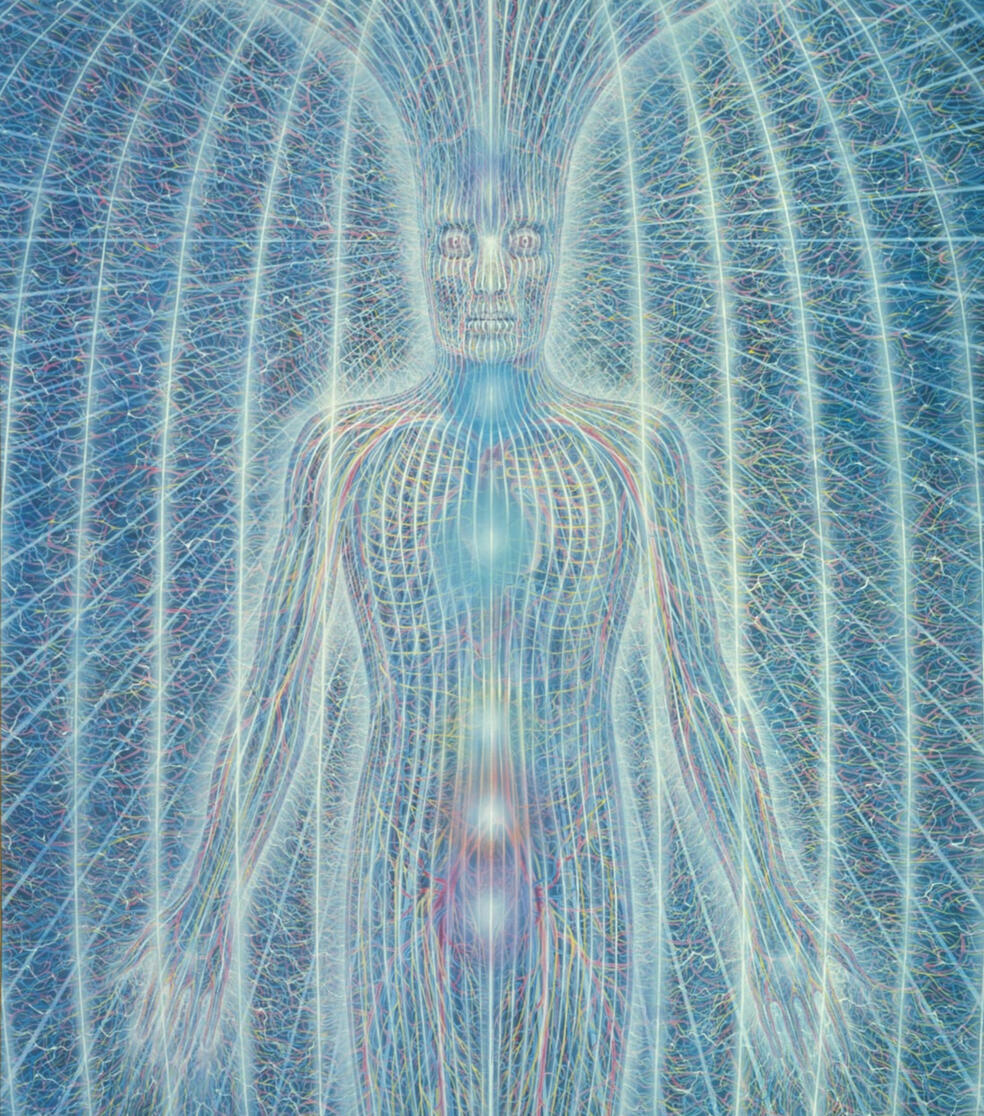
Spiritual Energy System by Alex Grey (1981).
Band 26 & Pivot 9 & Step 90 - This band/pivot/step is exemplified through the sentiment of 'wishing upon a star.' 'Miraculous' derives from the French miracle ('full of wonders'); from the Latin miraculum ('a wonderful thing') which inherently links it to [The Incantatory] band below. Continuing from footnote-B28 (Band 28): Hekate's name means 'one who works from afar' or 'the far-reaching' and links to hekaton ('one hundred'), which is appropriate for her genius loci dominance at 090 (or 900%). Similarly, the moon has historically been seen as a cosmic mirror. Indeed, it is a reflective disc for the sun's hidden light. 'Mirror' and 'miraculous' are linguistic twins, in fact, as miraculum and miratorium share the root mirari ('to wonder at'). Incidentally and completely unrelated, but the Japanese word mirai (未来) means 'not yet to come' or 'future.'
Hekate's mother was Asteria ('of the stars') and her father was Perses ('destroyer'). This conceptually links her to Asterion and the monstrous ('divinely ominous') through nomenclature and heraldry. Asterion is literally condemned to a matrix of crossroads (of which Hekate governs): a crossroad can be called a trivium, where we derive 'trivia' (which commonly infers something 'trifling,' a 'small fact'). This is likely owing to the way crossroads functioned as places for people to gossip or share small bits of news in passing. The evolution of the word trivia is profound and befits the emergent-miraculous scaling (meta > giga-mega > macro > meso) shown throughout [The Divine] and [The Prismatica] and beyond (meso > micro > atomic > subatomic > quantum | meta).
One last remark: the Monstera genus of plant is named that because of their large leaves with natural fenestrations that make them appear abnormal. The Monstera features a rare physical trait where the leaf is duo-toned, with one half appearing a solid green and the other a cream. Interestingly, this variegation patterned plant has received the nickname 'Half-Moon Monstera'.9 - Ordinarily improbable yet extraordinarily probable.[[[[[DELINEATE HOW DIVINE INTERVENTION IS EXTREME IMPROBABILITY IS COINCIDENCE IS SYNCHRONICITY IS UNMEASURABLE AS IT IS NON-POSITIVISTIC, UNFALSIFIEABLE, NON-EMPIRICAL BY ITS NATURE - THEN MORPHOGENIC FIELD THEORY?]]]]
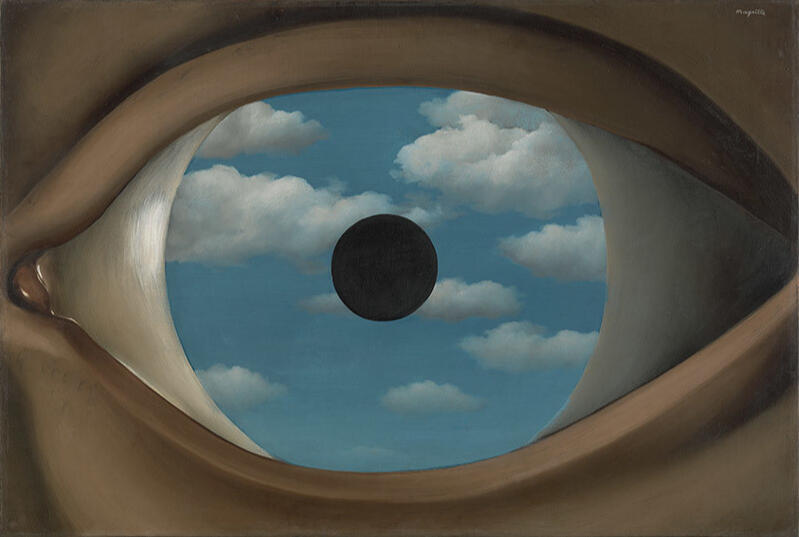
The False Mirror by Rene Magritte (1928).
Domain 8 - 'Incantation' derives from the Latin incantare, meaning 'to chant upon, sing magic over, or charm' before its Old French definition of hexing. It appropriately shares the Latin root with the word 'enchant.' 'Hex,' meanwhile, derives from the German hexe from hecse from hagazussa - which is where we arrive at the contemporary doublet definition of a hag as a witch or female demon. The term 'hex code' in relevance to colour derives from hexadecimal ('six and ten') to describe a base-16 system. The two hex- prefixes are unrelated, but connected here through an association of magic and colour.10 - There's an ancient Gaelic ritual meant to bring about imbas forosnai ('illuminating knowledge'), the highest state of gnosis whereby the poet becomes a vessel for transcendental vision. Due to the ritual's use of offerings, it was outlawed by Saint Patrick in favour of díchetal do chennaib ('incantation through the fingertips'). It's somewhat comparable to seiðr ('cord' or 'string') - the Norse shamanistic method of shaping fate through trance and divine communication.
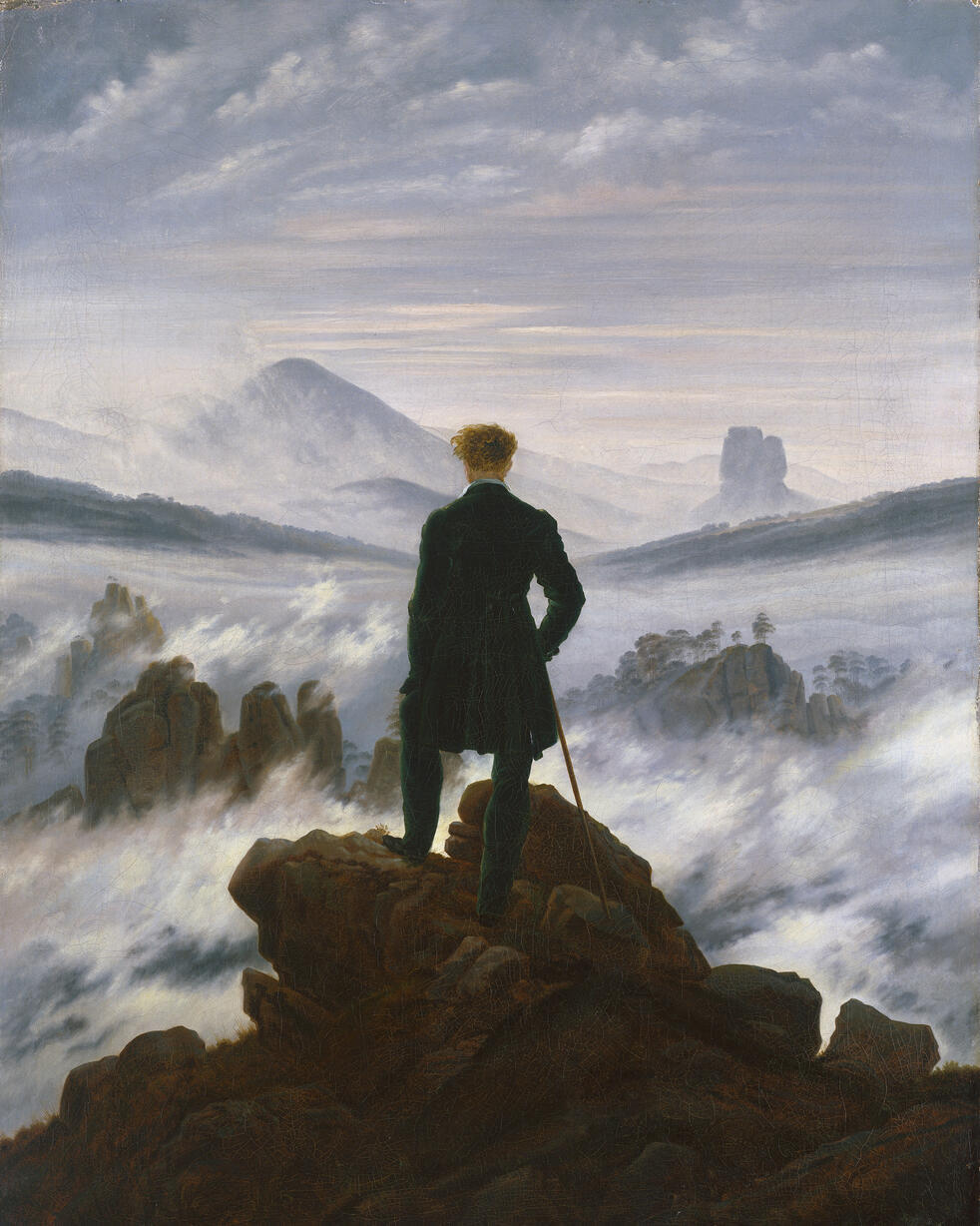
Wanderer Above the Sea of Fog by Caspar David Friedrich (1818).
11 - Plato's Cave is an allegory from The Republic (Book VII). There, he posits a situation where prisoners are chained inside a dark cave from birth, unable to turn their heads while a fire burns behind them. Puppeteers cast shadows on the walls. The prisoners believe this is indicative of reality (as it is all they've ever known). Were a prisoner to free themselves, the blinding and enlightening reality outside would compel them to tell the others. I've inverted the story for the sake of The Syncodex, where our Plato (prisoner) turns further from the sun (The Divine) (katabasis) for gradual forms of declining light and illusion until he becomes a monster, then the cave - then the darkness itself.12 - [[[[[CHAOS MAGICK AND SIGILISM AND RITUAL MANIFESTATION]]]]]
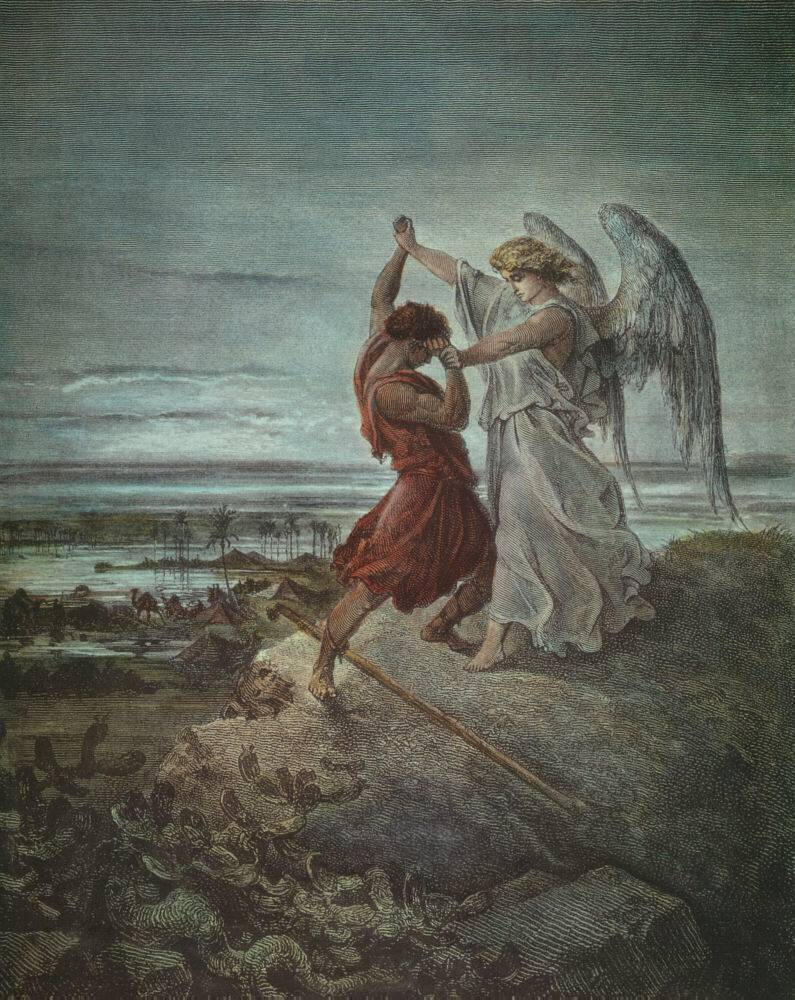
Jacob Wrestling With the Angel by Gustave Doré (1855).

Domain 10 - 'Divine' derives from the Latin divinus, meaning 'godlike.'Band 30 & Step 102 - 'Empyrean' derives from the Ancient Greek empúrios, meaning 'fiery' but later transmuted into the Latin empȳreus to mean a 'highest heaven of pure fire' before adopting its common meaning of 'dwelling of God.' We see the beginnings of light already.
'Any sufficiently advanced extraterrestrial intelligence is indistinguishable from God.' - Shermer's Last Law, the Last Law by Michael Shermer (2002).
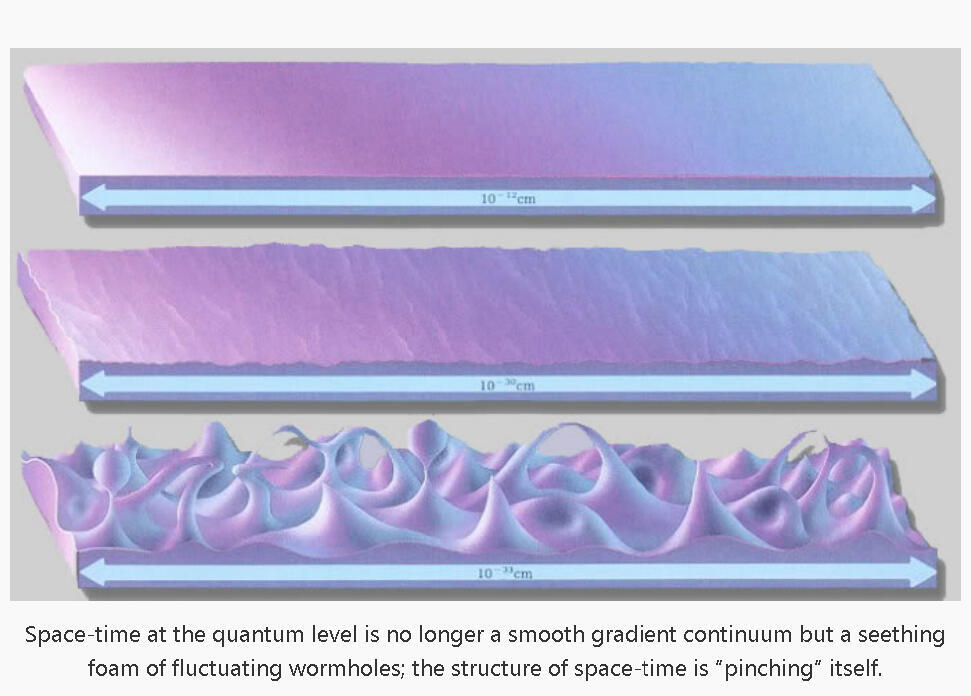
Quantum Gravity and the Holographic Mass by Nassim Haramein (2013).
0 - Characterised by its high-energy chaotic nature, quantum foam is the infinitesimal 'virtual particles' derived from zooming into spacetime, like the artefacts one might find from enhancing a 4k image (times infinity). Nassim Haramein - in his fringe paper Quantum Gravity and the Holographic Mass (2013) - attempted to challenge this chaos by ordering this quantum foam ('fundamental fabric of the universe' - at the Planck scale (10^35 meters) into a deterministic structure, claiming this vacuum possesses an infinite density that connects all things via fractal 'Sacred Geometry' and Mandelbrot scaling).
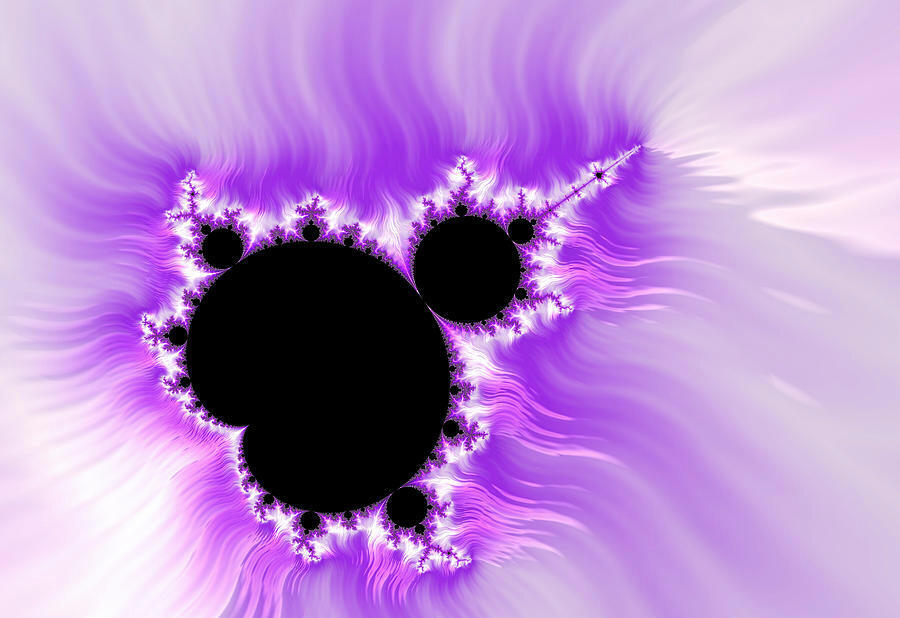
Purple Mandelbrot Set by Matthias Hauser (2014).
Band 29 & Pivot 10 & Step 101/100 - 'Transcendent' derives from the Latin transcendere, meaning to 'climb over' but it later defined a 'pre-eminent' state beyond physicality. What are we climbing over - but the aforementioned 'membrane of magenta conceptually inferior to the transcendent but superior to the celestial?'
'When a distinguished but elderly scientist states that something is possible, he is almost certainly right. When he states that something is impossible, he is very probably wrong. The only way of discovering the limits of the possible is to venture a little way past them into the impossible.' - Profiles of the Future: An Inquiry into the Limits of the Possible, the First and Second Laws by Arthur C. Clarke (1962).
So we must 'do the impossible, see the invisible; touch the untouchable, break the unbreakable; break the rule, then you see the truth ' - Libera me from Hell by Taku Iwasaki for Tengen Toppa Gurren Lagann (2007).1 - Considering the function of a band is to split a domain, and [The Divine] features only two different adjectives to describe it, those steps are this domain's bands. Also, it's worth noting that applying topology through architectural terminology is nonetheless reductive here as we are concerned with an almost unconditioned spirit beyond the celestial which infringes upon a realm of pure light. We are using architectural terms because human language is clumsy, but remember that we are talking about the behaviour of light (to denote the reactivity of an idea upon my nervous system). We use the utmost hyperbolic language to describe...
Well, the utmost.

0 - Towards the beginning of I Am a Strange Loop, Douglas Hofstadter (2007) confers a moment in his childhood when he was looking at a photograph of his late father. His despairing mother said, 'What meaning does that photograph have? None at all. It’s just a flat piece of paper with dark spots on it here and there. It’s useless.' In his sentimental but nonetheless rational attempts to explain how he felt his mother was wrong in this assessment, he arrived at the conclusion that a part of his father's 'soul' was attached to the photograph: a 'soul shard.' Coincidentally, Harry Potter and the Deathly Hallows, by J. K. Rowling (2007) was released only four month after I Am a Strange Loop and directly concerns the recovery of the villain's Horcruxes (which is suggestive of etymological dissection, though Rowling invented it randomly). Horcruxes are literally 'soul shards.' Though Rowling did not invent the concept. From the author's memory: Djinn and Genies (who reside in their containers - which isn't the exact same and operate more like Pokémon); The Immortal Koschchei (of Slavic myth whose soul is hidden in a needle); The One Ring (carries the essence of Sauron's will) (1937); the Portrait of Dorian Gray (1890) or (wonderful in this example) Alphonse Elric himself from Fullmetal Alchemist (2001). Even the 5th-level magic spell Magic Jar (1974) predates both Harry Potter and Douglas Hofstadter. Before Alfred Binet and Sigmund Freud shifted the definition to sexual psychology, a 'fetish' (derived from the French fétiche) was 'an object believed to possess an inherent spiritual power.' We can trace that word's roots further to the Latin factīcius ('artificial, 'fabricated') and discover a Middle Age evolution of etymology capable of conveying the spiritually created. Fetishes everywhere - can you argue? We see here the tension behind theological idolatry. This ancient motif of an External Soul dates back to antiquity.
0.1 - I believe a person dampens their interaction with reality when they limit their umwelt reality tunnels and nervous system's semiotic-experiential response networks. By conditioning themselves into reductive and hyperbolic expression of thought (such as 'peak') to describe optimal experiences, they contribute to an escalating trend of exaggeration, expectation, and disappointment while disrespecting the art and the artist. The short, snappy delivery is a condemnation matched in the over-exaltating 'peak.' It's the peak/mid/trash, hot/lukewarm/cold, smiley/neutral/frowny face scale all over again. We are being trained by one another and social media to reduce our expression of consciousness to emoji and pithy statements at increasing volumes in an echoing feedback loop building to a fever-pitch.
Let's briefly discuss the contemporary efforts to replace spirituality with fandom. Modern intellectual-properties are switching to multi-verse narratives, constant patching, updates, sequels, and forever content. Owners of these IPs now desire fan-contribution (largely pornographic) to keep their imagined realities alive and thriving. This is a psychodynamically endorsed and currently effective push towards dominating the disciplined practice once reserved for religion. With enlightenment came industrialisation came mass-secularisation came globalisation came the internet came fandoms – which is the capacity for an individual to worship what once were decried ‘false idols.’ Fandoms are alive where ‘God is dead’ to many. Friedrich Nietzsche, John – more popular than Jesus – Lennon, and Kanye – I am a God, Yeezus, Ye – West, understand this overtly. These fandoms contain the social connections required to stave off Durkheim’s anomie (which is, ostensibly, the lonely result of disentangled non-conformity) but also operate as hotbeds for radicalisation and deindividuation. ‘Getting lost’ down the ‘rabbit-hole’ of something is encouraged, so the observer stays myopically within a single sub-culture (if possible); an echo chamber, and really, a financial ecosystem. This is one of the many symptoms of a dying Western monoculture (or, indeed, global monoculture). Fandoms have subsequently adopted cognitive techniques of in-group language, figureheads of love and hate, gatekeeping and enlisting rhetoric, adoption of practice, proving oneself to the pack, and other such sub-cultist practices that can foster ostracisation, critical thought, conformity, opposition, and deindividuation - all to incentivise further tithing. And now we make each other famous influencing idols; Warholian five minute celebrities. We’ve exploited the infinite. We’ve exploited the finite. We’ve even exploited a self-awareness of this to lampshade seriousness.
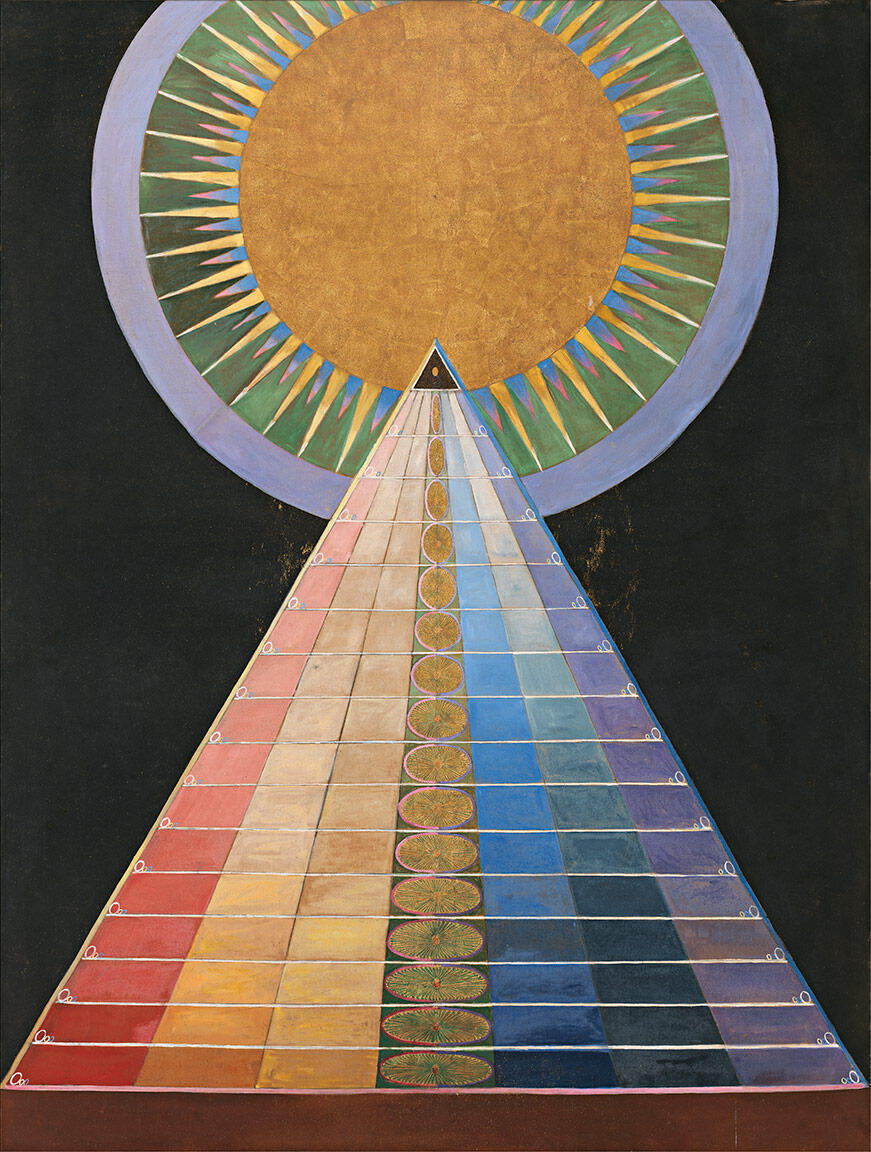
Altarpiece No. 1, Group X by Hilma af Klint (1915).
0.2 - Are we not evaluating the art itself? - and not just how the art made us feel? While the two are almost inexorable, they can be separated through example. You leave the cinema having seen an awful movie with your friends. You might have had a great experience, laughing at its ineptitude for two hours, yet can critically distinguish between the dissatisfying movie and the great experience to determine whether that dissatisfying movie was responsible for the great experience, or some other confounding variable(s). Does the work stand on its own or require copious propping? Is it the timber for self-construction or the kindling for a social bonfire? The capacity to critically distinguish between the two is contingent on many factors - age, self-awareness, discrimination and compartmentalisation, fatigue, intrusive thoughts, neurochemical interference, convention familiarity, aesthetic literacy, temporal proximity, metacognitive friction, and many other predispositions or biases.
On that note, The Syncodex does not pretend to be objective but entirely insists subjectivity: an autobiographical map of signal decay through art upon a nervous system. I recognise my favourite works might not be 'flawless' - far from it, perhaps - but those 'flaws' have been 'forgiven' or 'excused,' overruled by a personal value. This is not about finding 'perfect' art, for 'perfection' ever evades us - an impossible illusion forever out of reach best expressed through Zeno's paradoxical arguments against motion and change. Like a cat following the red dot of a laser, we grasp what we think to be perfect only to find it has moved from under paw.
0.3 - 'It's not that deep,' betrays the shallow. Is The Syncodex an exercise at taking the world literally literally? Yes.
0.4 - To achieve a 4.5* a work needs to receive a syncrate of 999%-900%. Securing an [A+] requires between 999% and 967%, an [A] requires between 966% and 934%, and an [A-] between 933% and 900%. This can be illustrated through Signal-to-Noise Ratio, where the frequency signal is strongest at the top, closest to the transmission, the signal below drowned out by interference: noise. Were this The Telephone Game, a higher syncrate is the result of the first player whispering directly into the ear, the signal of lower scoring entries fraying and decaying until complete distortion at the bottom.0.5 - What better exemplifies the relative nature of The Syncodex than the use of colours themselves? You might disagree and say red belongs to the apex because it represents love, and love should be the word to denote 100. You are also free to believe blue should come before black near the top to illustrate the sky before space. Here is what logically works best to the author. That said, let us clarify that red art is not inferior to blue art, nor would art belonging to [The Prismatica] ever be described as 'purple art' because that is not appropriate as we discuss a nervous system's attunement response to wavelength emission (ability to 'vibe').
'When you look at someone through rose-coloured glasses, all the red flags just look like flags.' - Wanda Pierce in BoJack Horseman (2015).0.6 - Why do people wait weeks or months to hear the words "I love you" come from the mouths of the one they love? When they said, the other day, "I need a drink, I'm so thirsty," why does the nervous system not reciprocate the desired response? Why did the nervous system require that specific phonetic stimuli? Because words carry meaning. They are not only the rungs of a ladder of communication, but the rungs of a ladder to actualisation and transcendence; a labyrinthine system of revelatory etymology. This is a selfish essay but I disagree with my inner-voice that derides me for hermetic naval-gazing. Language is labyrinthine and this essay is an attempt at navigating that labyrinth. You can't map a hall of mirrors by pretending it's a straight hallway. These words bounce off each other through time and space.0.7 - Think of the Möbius strip (1858): a surface with a single side and boundary curve created through a half-twist (180°) of the band before the ends join. You could draw a line down the middle of the band and return to the origin of that line without once lifting the pen. So, unlike a typical loop it possesses only one continuous edge (not just a 'top' and 'bottom'). That drawn line travels around the loop and returns to the start, but its orientation has changed, image flipped as if in a mirror. Though Ferdinand Möbius coined the term, depictions of the 'trick' can be found in Ancient art and machinist/mathematical tradition. It's linked to the ourobouros, the figure-8, the infinity symbol, subsequently the works of M.C. Escher and, uh, Sonic the Hedgehog who can enter a figure-8 Super Peel Out (or approximately 12.6 m/s to 14.6 m/s or 28 to 33 mph)) top Dash before boosting (80 m/s or 179 mph) into a relative Mach 1 (316.8 m/s (708.6 mph). And that's before Super Sonic light speed.
'We are not going in circles, we are going upwards. The path is a spiral; we have already climbed many steps,' - Siddhartha, by Hermann Hesse. Though that quote applies to travelling along an ascending spiral or helix, its ontological twist on geometry matches the Möbius strip. In both circumstances, the traveller encounters repetition as they journey through the infinite (as is the case with Sisyphus) and only an altered state of mind can reinforce novelty and hope (information and negative entropy).
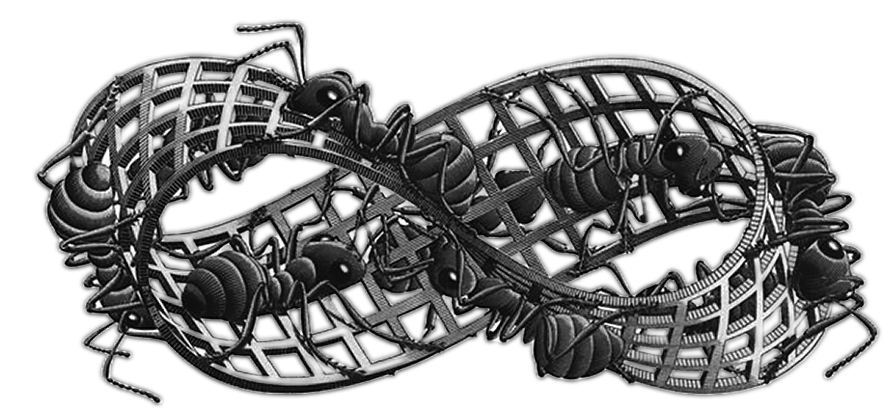
Möbius Strip II (Red Ants) (desaturated) by M. C. Escher (1963).
0.8 - Everything above worthwhile had a worthwhile affect upon the nervous system. Entries below significant struggled to affect the nervous system in a way considered generally significant, even if they are satisfactory or worthwhile. An entry deemed transcendent possesses the attributes of wonderful, outstanding, good, adequate, passable but not mediocre - or below. Similarly, an entry deemed abysmal would possess the attributes of vile, bad, inadequate, mediocre, but not passable - or above. The three instances of whatever in the middle represent a linguistic stall: an apathy represented through vocabulary indifference. As above, so below until we reach centre - then: as below, so above.
Entries are more plentiful towards the bottom of each domain than the top, representing the climb required to cross the bands through a pivot into the next domain. There is not an even bell-curve distribution as that would be an unnatural representation, sacrificing representation for statistical aesthetics. However, there are more entries around 800% to 600% and 400% to 200% than either polar or centre, which reflects how a person (or at least the author) experiences media. It's hard to remember forgetful things, and impactful entries are rarer, so it stands to reason more works would aggregate at these points. Towards either end of The Syncodex, descriptive language changes from the casual, formal, or academic seen around the centre, to a Latinate/Greek and ancient vernacular reflective of its oppositional pole. This is explained through the etymological footnotes.
0.9 - The Ancient Egyptians referred to their homeland as Kemet ('The Black Land') from the root word kem ('black') to denote the fertile silt left by Nile floods. When the Greeks invaded, they adapted this name into Khēmeia ('the Egyptian art'). The city of Letopolis (originally Khem) was revered and feared by the Greeks as an ancient centre of ritual, geometry, astronomy, and metallurgy. This later became the Arabic al-kīmiyā. Contemporary occultists (and psychologists) continue to use alchemy as an appropriate metaphor for transmutation of reality ('As Above, So Below'). Sir Isaac Newton wrote more on alchemy than any other subject. 1/10th of the 10 million words he wrote concerned the subject. There was no sharp distinction between 'science' and the occult for him. Influenced by Hermetic philosophy, his search for an active spiritual force operating through the universe influenced all of his laws of motion and gravitation. Most of these writings were kept a secret in his lifetime as it was legally restricted in England to study alchemy, with us only discovering them long after his death. Nonetheless, he ran the Royal Mint (first as Warden and later as Master), taking over the Mint during the Great Recoinage of 1696. Decades of metallurgical practice melting, testing, and documenting gave him experience with bullion. He tracked down counterfeiters and coin-clippers, and established the gold-to-silver exchange which assisted the gold standardisation of Great Britain. Alchemy concerns the transformation of matter and is the forerunner to modern 'chemistry.' Some alchemists pursued the 'Philosopher's Stone,' a legendary substance believed to turn base metals like lead into gold (and ultimately able to grant immortality: technical or literal, depending on who you ask). The alchemist undergoes transformation during their 'Magnum Opus' ('Great Work') along a four-stage process. Those four stages are nigredo (blackness), albedo (white) , cinereus (ash), and rubedo (red). Coagula ('condensation') et ('and') solve ('dissolution').
'Roughly speaking, if you can mass-produce it, it’s science, and if you can’t, it’s magic. As an example, suppose someone says she can transform lead into gold. If we can use her technique to build factories that turn lead into gold by the ton, then she’s made an incredible scientific discovery. If on the other hand it’s something that only she can do, and only under special conditions, then she’s a magician. And I don’t mean that she’s a charlatan; she might actually be able to transform lead into gold. But scientific phenomena are reproducible by other investigators; they aren’t dependent on a specific person.' - Ted Chiang0.10 - It is somewhat comparable to how, in Kabbalah, the immanent residue of the upper Sefirot converges within Malkuth, bringing Malkuth closer to Kether. But it is not Kether.
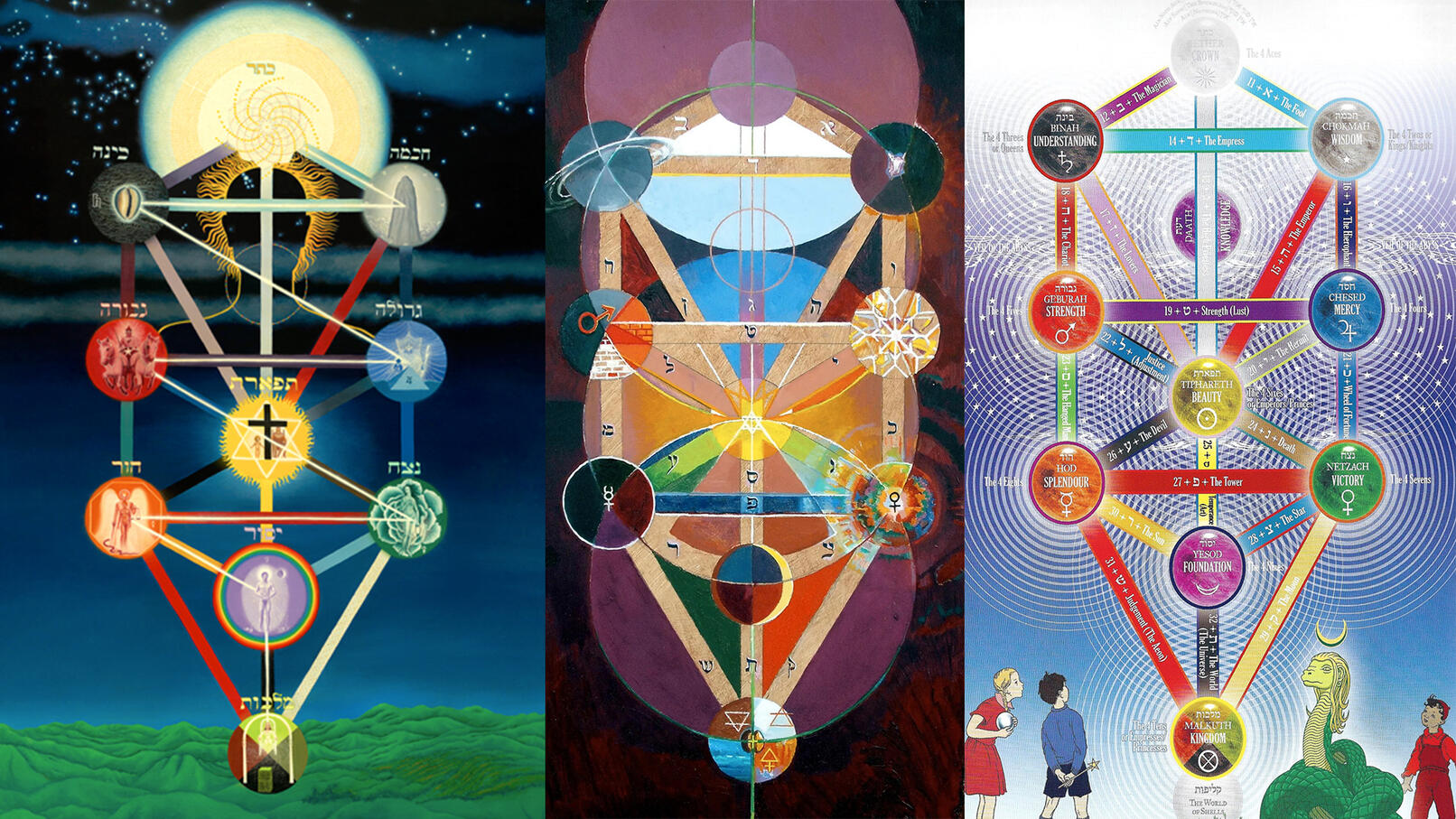
Tree of Life, by Patricia Waldygo (1982); Jane Adams (1989); John Coulthart (2024).